Are Plastic Sheds Any Good? UK Pros, Cons and Failures
Written by Matt W on 13th Aug 2026.
Plastic sheds are good for dry, low-maintenance garden storage when the frame, floor, ventilation and anchors are properly specified. They do not rot or need painting, but they are unforgiving of an uneven base. Most failures blamed on plastic begin with poor levelling, omitted anchors, blocked vents or an undersized doorway. The wall material is rarely the first problem.
Key takeaways
- Buy the complete structure, not simply “a plastic shed”: frame, floor, doors and vents matter.
- An integrated floor still needs a firm, flat foundation underneath it.
- Check the real millimetre dimensions; two sheds sold as 7x7 can have different footprints.
- Use only the manufacturer's fixing points for anchoring, shelves and accessories.
- Plastic needs less surface maintenance than timber, but it still needs cleaning and inspection.
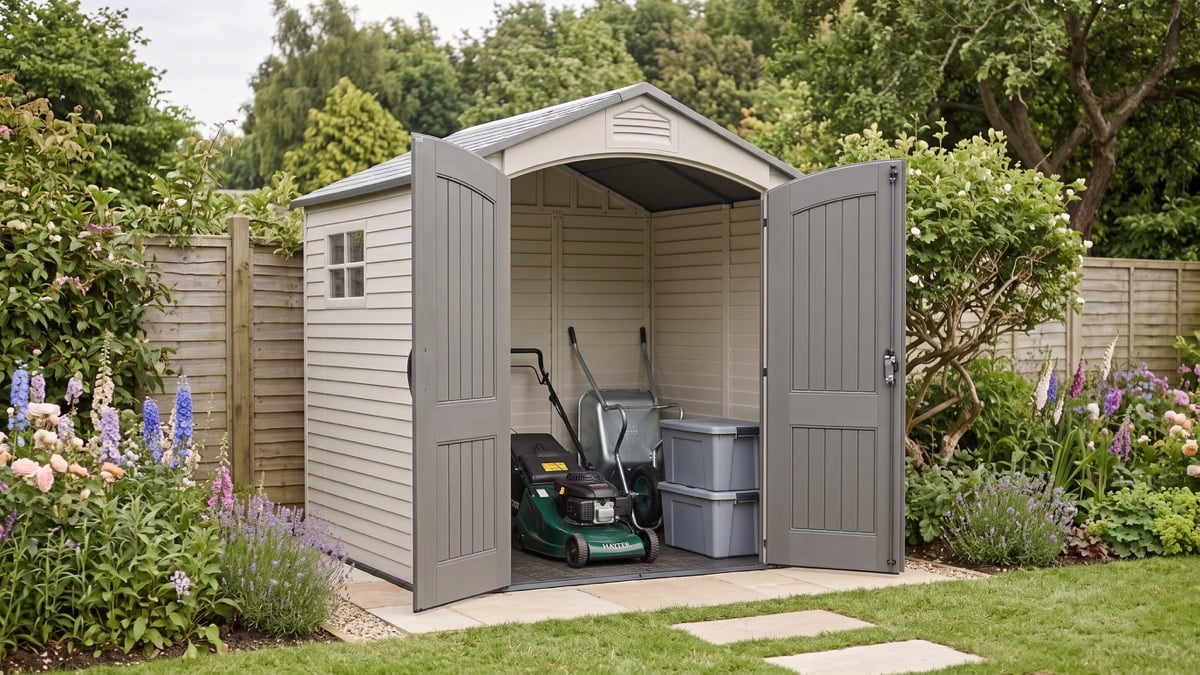
View the Lifetime 7x7 Plastic Shed →
Installer's Note from Matt W: I treat the moulded floor as part of the shed, not as its foundation. Before assembly, I check the supporting surface in both directions and across both diagonals. If the base is out, panels fight their fixings and double doors stop meeting cleanly.
- Matt W, Garden Shed Stores
Are plastic sheds any good?
Yes, a well-specified plastic shed is good for everyday garden storage.
Its strengths are straightforward: no timber treatment, no rusting wall sheets and a surface that is easy to wash. Better models add a metal frame, a moulded floor, screened ventilation and doors that accept a padlock.
The category is not uniform. Our 13 August 2026 catalogue check found 50 plastic-shed listings. They covered compact pent stores, conventional apex sheds and large steel-reinforced buildings. Judge the exact product, not the material label.
| Your priority | Plastic is a good fit when... | Look elsewhere when... |
|---|---|---|
| Low upkeep | You want washing rather than painting or staining | You enjoy refinishing and repairing timber yourself |
| General storage | The floor, doorway and shelving system suit your kit | You need to screw custom fittings anywhere on the walls |
| Exposed position | The specified anchors can be fixed into a suitable base | You cannot anchor the building as instructed |
| Workshop use | You only need occasional light tasks | You want heavy benches, extensive wiring or wall-mounted machinery |
| Appearance | A moulded wood-grain or modern resin finish suits the garden | You want to repaint the shed when the garden changes |
What are the advantages of a plastic shed?
The main advantages are low surface upkeep, rot resistance and useful integrated features.
Polyethylene and polycarbonate walls do not need preservative. A hose, soft brush and mild detergent deal with most dirt. An included floor can protect stored items from the prepared base, while translucent roof panels or windows bring in daylight.
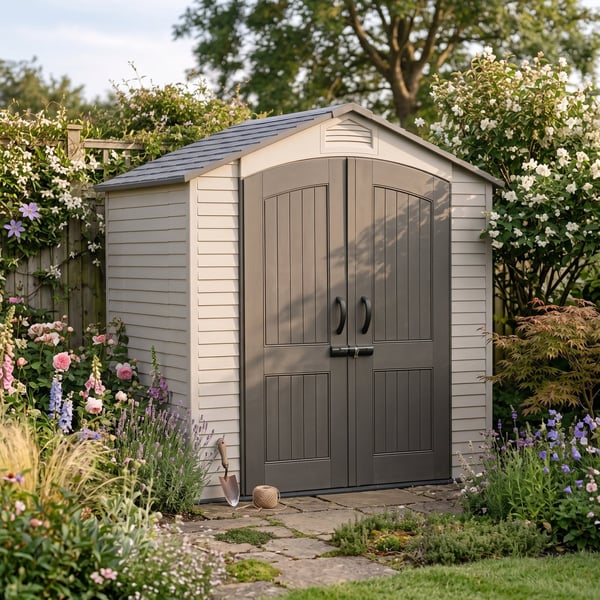
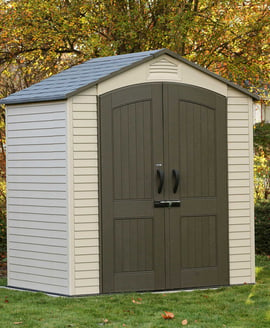
The current Lifetime 7x4.5 illustrates the practical package: steel-reinforced double-wall HDPE panels, a slip-resistant floor, screened vents and 1370mm-wide double doors. Its external depth is 1420mm, making it a narrower alternative where a full 7x7 footprint is too deep.
What are the disadvantages of a plastic shed?
The main disadvantages are limited customisation, dependence on correct assembly and model-specific replacement parts.
You cannot assume a plastic wall will accept an ordinary shelf bracket. Use the manufacturer's shelf system or reinforced fixing locations. Drilling an unapproved hole can admit water, weaken a panel or affect warranty cover.
Plastic also expands and contracts with temperature. The maker's slot positions, washer order and screw tension allow for that movement. Forcing panels into place may produce a neat-looking shed on assembly day and a door problem later.
Why do plastic sheds fail?
Plastic sheds usually fail because the base, anchors, assembly or ventilation was wrong.
- Uneven support: a twisted floor pulls door openings out of square.
- Missing anchors: a lightweight shell can move in strong wind.
- Loose or overtight fixings: the frame loses rigidity or panels cannot move as designed.
- Blocked vents: wet equipment keeps the interior humid.
- Wrong shelving: loads are placed on panels rather than reinforced points.
- Poor clearance: gutters, fences or plants prevent cleaning and inspection.
- Doorway mismatch: the shed has enough floor area but stored equipment cannot pass through the opening.
Use the shed base guide before ordering materials. For this material specifically, read why a plastic shed with a floor still needs a foundation.
Do plastic sheds get condensation?
Plastic sheds can get condensation when moist air is trapped inside.
The walls do not generate water. Wet mowers, damp soil, standing water at the base and restricted airflow supply moisture. Bring in dry equipment where possible, keep vents open and leave a small air gap behind boxes.
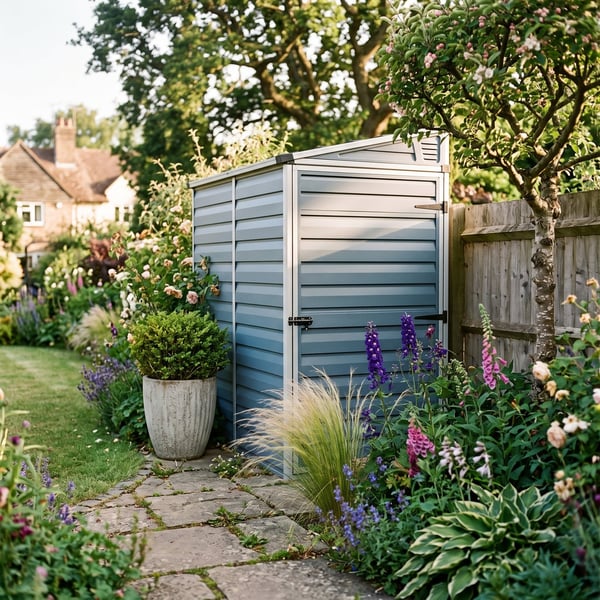
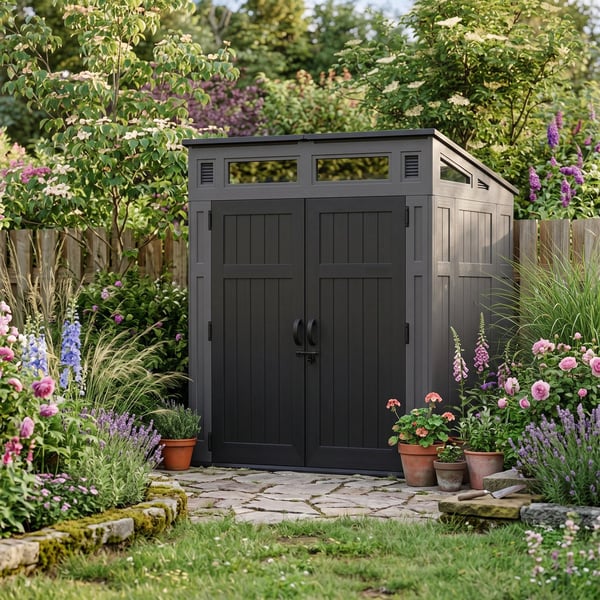
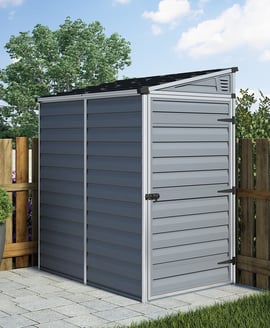
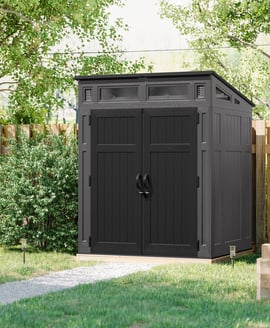
Vent design differs. The Palram Rubicon uses mesh-covered apex vents. Lifetime's 7x7 has two screened vents, while the Suncast Modernist has functional vents near its transom windows. Compare those details before assuming every resin shed behaves the same.
Do plastic sheds need a base and anchors?
Yes, plastic sheds need both a suitable base and the specified anchors.
An integrated floor spreads loads inside the building. The base below keeps that floor flat and stable. The anchors tie the shed to the support. These are separate jobs.
Follow the instructions for anchor type and fixing location. Do not make improvised holes in panels. If the site is exposed, solve its anchoring before assembly. Replace or repair any paving that rocks underfoot. Correcting a twisted building afterwards is far harder.
Failure-point check: Close and latch both doors before final tightening. If the gap changes from top to bottom, recheck the base and frame diagonals. Do not cut the doors to disguise a twisted structure.
How secure is a plastic shed?
A plastic shed is suitable for ordinary storage when its doors, frame and anchoring are secured together.
A padlock loop alone does not define security. Look at the material behind the hasp, whether hinges are exposed and how the whole shed fixes down. Keep valuable bikes locked independently inside rather than relying on the door lock alone.
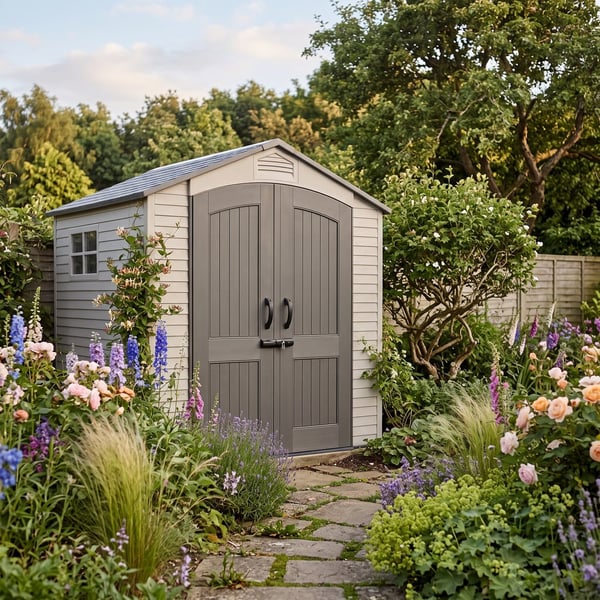
The Lifetime 7x7 uses steel-reinforced doors with an exterior padlock loop and internal deadbolts on the inactive door. The official specification says the padlock is not included. Our shed security guide covers locks, internal anchors and insurance evidence in more detail.
How long should a plastic shed last?
A plastic shed has no honest universal lifespan, so compare construction and warranty terms instead. Our plastic shed lifespan guide separates a ten-year warranty from a realistic 10-20 year planning range.
Sun exposure, wind, base movement, assembly and replacement-part availability all affect service life. A headline such as “20 years” is less useful than knowing what the warranty covers and what can invalidate it.
Each shortlisted range carries a 10-year limited warranty in the specifications checked on 13 August 2026. The Lifetime manual excludes damage caused by incorrect installation, alteration and neglect. Read the exact document supplied with your model.
Manufacturer references: Lifetime 60042 specification, Canopia Rubicon 6x8 and Suncast BMS7780 specification.
Is a plastic shed right for me?
A plastic shed is right if low upkeep matters more than unlimited customisation.
Measure the largest stored item, including handles and wheels. Compare that number with the stated door aperture, not the nominal shed size. Then confirm the base, anchors, ventilation and approved storage accessories.
If you are still comparing materials, read wooden vs metal vs plastic sheds. For exact model recommendations, continue to our best plastic sheds UK comparison. The broader Garden Shed Buying Guide joins size, material, base and budget decisions.
Compare compact plastic sheds
Frequently asked questions
Are plastic sheds waterproof?
They are designed to keep normal weather out when correctly assembled. A level base, fitted roof parts and clear seals remain essential.
Can you put shelves in a plastic shed?
Yes, using the manufacturer's approved shelf points or accessories. Avoid drilling unsupported wall panels unless the instructions explicitly allow it.
Can a plastic shed blow away?
Yes, an unanchored plastic shed can move in severe wind. Use the specified anchors into a suitable base and inspect them after storms.
Do plastic sheds need maintenance?
Yes, but routine maintenance is light. Wash the panels, clear vents, inspect seals and check anchors and door alignment.
Can I store a lawn mower in a plastic shed?
Yes, if the mower fits through the door and the floor supports it. Let the machine cool and dry before storing it.