How Long Do Plastic Sheds Last in UK Weather?
Written by Matt W on 17th Aug 2026.
Expect 10-20 years from a well-specified, correctly installed shed.
Three stocked examples each carry a 10-year limited warranty.
An uneven foundation distorts doors, floors and panel joints.
Products and manufacturer guidance checked 13 August 2026.
A well-specified plastic shed can serve for 10-20 years in UK weather. Its foundation must stay level and its anchors remain sound. A warranty is not a promised lifespan. Three current Garden Shed Stores examples use different structures, yet each carries a 10-year limited warranty. Base movement, loose fixings, blocked drainage and impact damage usually deserve more attention than routine panel washing.
Key takeaways
- Treat 10-20 years as a sensible planning range, not a manufacturer guarantee.
- A 10-year warranty covers stated defects. It does not predict the retirement date.
- UV protection helps panels resist fading, warping and cracking.
- A level foundation keeps doors square and panel joints properly engaged.
- Inspect anchors, doors, roof joints and drainage every spring and autumn.
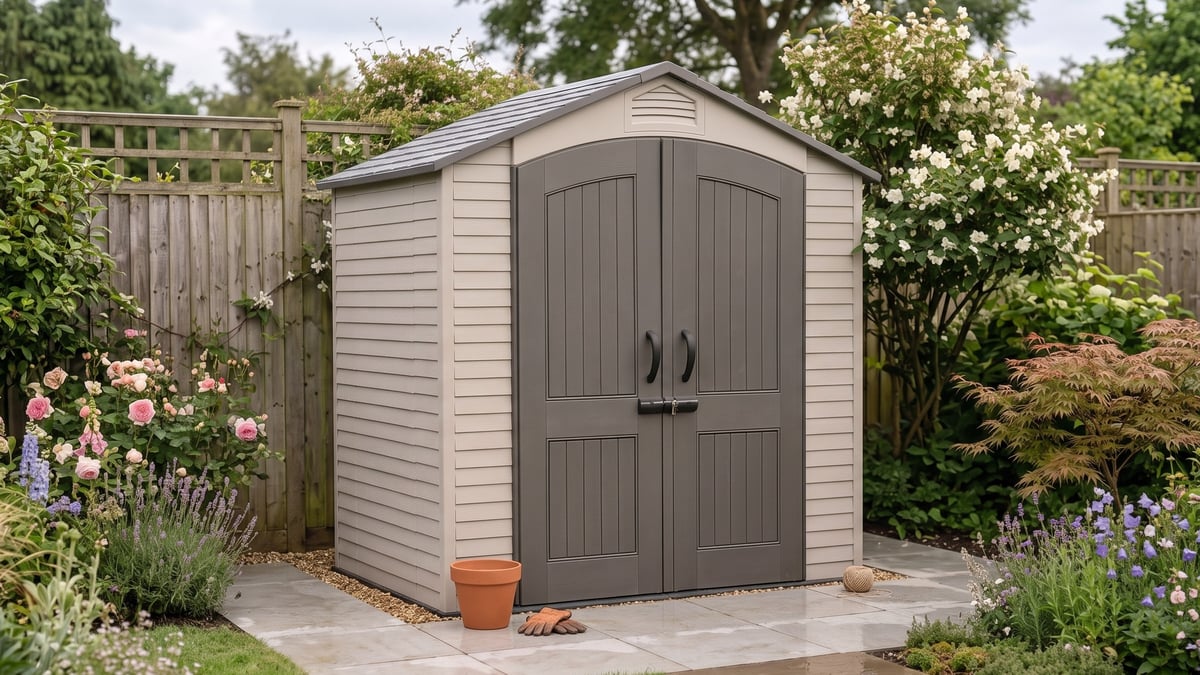
Installer's Note from Matt W: I judge an older plastic shed at the doorway first. Uneven door gaps usually point to base movement before panel failure. Measure both diagonals across the floor and compare them. A square base keeps the walls upright. It also lets the latch meet without forcing the doors.
- Matt W, Garden Shed Stores
How long do plastic sheds last in the UK?
A quality plastic shed should remain useful for 10-20 years with correct installation and basic inspection.
No manufacturer source checked for this guide promises a fixed 20-year service life. Lifetime, Palram Canopia and Suncast instead provide limited warranties. Each selected model carries ten years in our current catalogue.
The distinction matters. A shed can outlive its warranty. It can also fail earlier after storm damage, impact or foundation movement.
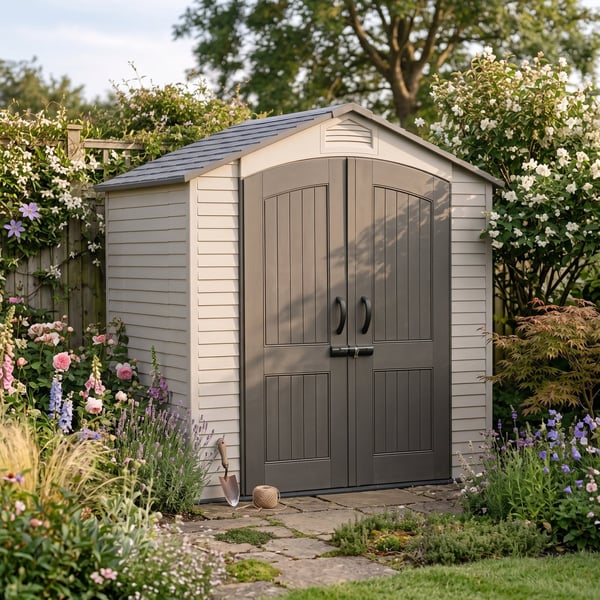
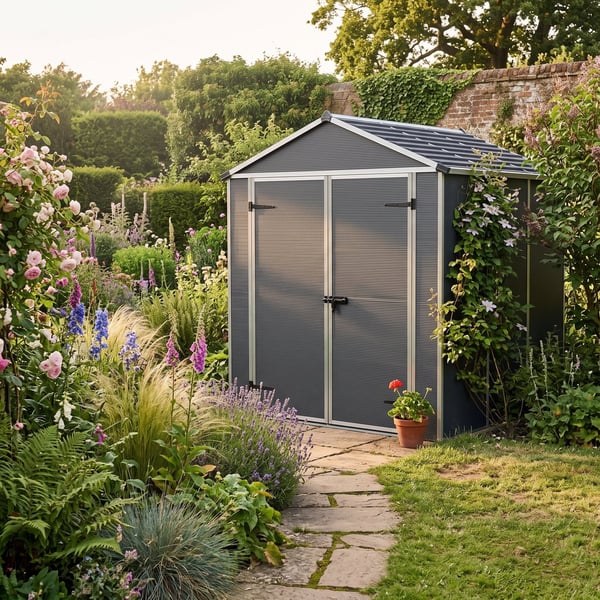
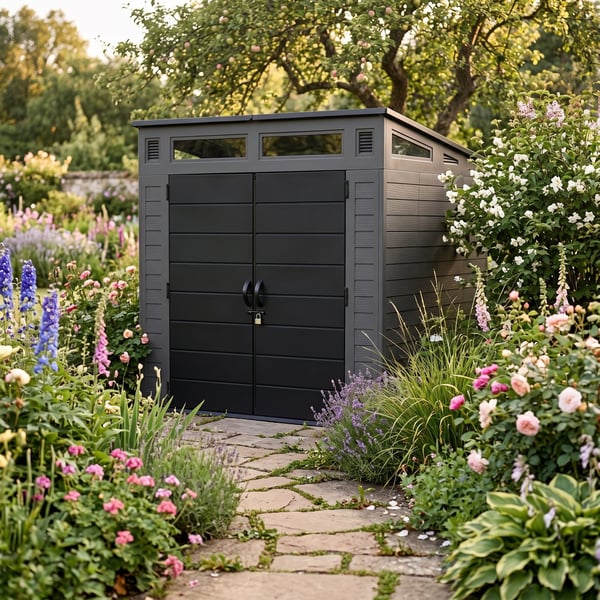
Construction affects the likely weak point. Lifetime uses steel-reinforced, double-wall HDPE. Palram's Rubicon combines 10mm polycarbonate panels with an aluminium frame. Suncast uses multi-wall resin around a steel skeleton.
Those systems resist rot and need no preservative treatment. Their doors, fixings, floors and anchors still need checking.
| Current model | Construction | External footprint | Checked warranty | Main longevity check |
|---|---|---|---|---|
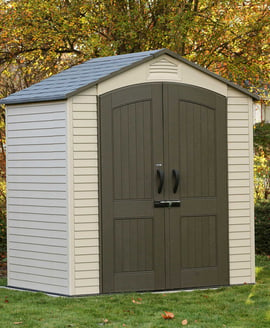
| Lifetime 7x4.5 | Steel-reinforced double-wall HDPE | 2070 x 1420mm | 10-year limited | Foundation level and floor anchors |
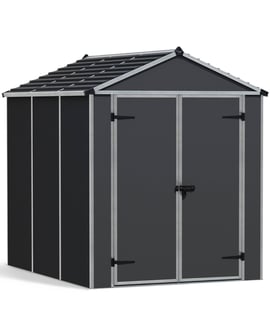
| Palram Rubicon 6x8 | 10mm polycarbonate and aluminium | 1750 x 2270mm | 10-year limited | Frame fixings and foundation anchors |
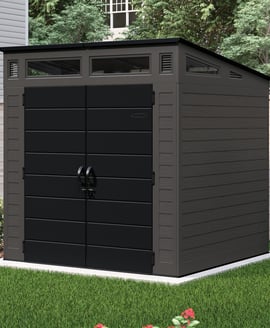
| Suncast Modernist 7x7 | Multi-wall resin and steel frame | 2200 x 2220mm | 10-year limited | Base level, roof joints and anchors |
Dimensions and warranties checked against current store records and manufacturer pages on 13 August 2026.
Does a 10-year warranty mean a plastic shed lasts ten years?
No, warranty length and expected service life measure different things.
A warranty sets the manufacturer's remedy for specified defects during a stated period. It also includes conditions and exclusions. Installation errors, poor foundations and severe weather damage may sit outside that cover.
Service life describes how long the shed remains useful. That depends on its structure, exposure, loading and upkeep.
Lifetime lists UV protection, steel reinforcement and a 10-year limited warranty for model 60057. Its official guidance still requires a flat, level foundation. The company also directs owners to model-specific anchoring instructions.
Canopia requires the Rubicon to sit on a solid, level surface. Its current instructions say to anchor the shed to the foundation.
Read the current warranty and assembly manual before laying any base. Do not rely on the badge alone.
What makes a plastic shed last longer?
A level foundation, correct anchoring and sensible loading do the most useful work.
- Build the specified foundation. A moulded floor spreads loads but cannot correct soft or sloping ground.
- Use every stated anchor point. The manufacturer chooses them to transfer wind loads through the structure.
- Keep water moving away. Clear leaves from roof edges and prevent soil from banking against the floor.
- Avoid forced doors. A dragging latch is an early warning that the shell has moved.
- Control wall loads. Use compatible shelves and brackets. Do not guess where internal steel sits.
Our plastic shed floor and base guide explains the foundation distinction. The broader shed base guide compares concrete, paving and grid systems.
Does UK weather damage plastic sheds?
Yes, but good materials and correct installation reduce the main weather risks.
Sunlight can fade or embrittle unprotected polymers. Current Lifetime specifications use UV inhibitors to resist fading, warping and cracking. Palram uses polycarbonate panels within an aluminium frame.
Wind is usually a structural problem before it becomes a plastic problem. Loose anchors let the shell move. Repeated movement enlarges fixing holes and stresses joints.
Rain exposes drainage and alignment faults. Water entering one corner may indicate a moved base, poorly seated roof panel or blocked channel.
Frost matters when trapped water expands inside a joint or below an unstable slab. Keep the perimeter clear and correct rocking paving.
For a wider material comparison, read wooden versus metal versus plastic sheds.
How do the base and anchors affect lifespan?
The base keeps the geometry correct, while anchors stop wind moving the complete structure.
These jobs are separate. An integrated floor supports stored items and connects the walls. The foundation below supports that floor across its footprint.
Lifetime says its sheds need a flat, level surface. Its FAQ recommends concrete or a suitable platform. Canopia accepts concrete, pressure-treated timber, decking or pavers for the Rubicon when properly prepared.
Our selected models range from 2.94m² to 4.88m² externally. A small fall across that distance can twist double doors enough to spoil their meeting line.
Check exact foundation dimensions in the current manual. Product size labels are not setting-out measurements.
Can a damaged plastic shed be repaired?
Minor hardware faults are often repairable, but cracked structural panels need model-specific parts.
Start with the assembly drawing and identify the exact component number. Ask the manufacturer whether that component remains available. Do not drill a new fixing beside a torn hole without approval.
Loose screws need careful treatment. Plastic can be damaged by overtightening, as Lifetime warns in its manuals. Tighten only enough to seat the specified joint.
Replace worn door hardware before it damages the moulded door. Clean compatible roof channels rather than sealing every joint with generic silicone.
A moved base must be corrected before cosmetic repairs. Otherwise, the same stress returns.
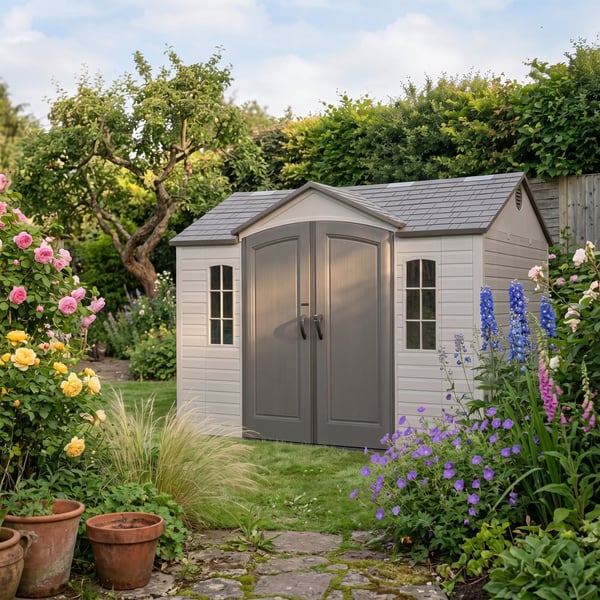
What should you inspect each year?
Inspect the shed twice yearly and after any named storm affecting your area.
- Check the floor remains fully supported and does not rock.
- Compare door gaps from top to bottom.
- Test every anchor for movement without loosening it.
- Look for lifted roof edges, open joints or damaged caps.
- Remove leaves and soil from the base perimeter.
- Check shelves have not exceeded their stated load or fixing method.
- Wash dirt with the manufacturer's approved method.
Record one photograph from each side. Year-to-year comparison reveals movement and fading more reliably than memory.
Which plastic shed construction should you choose?
Choose by structure, foundation requirement and available parts rather than lifespan claims alone.
HDPE suits buyers wanting a substantial moulded shell with steel reinforcement. Polycarbonate panels create a lighter framed system with useful daylight. Multi-wall resin and steel provide another rigid option.
Compare current models in our best plastic sheds guide. Read the plastic shed failure guide before choosing.
Browse the current low-maintenance shed range →
Plastic sheds with ten-year warranties
Frequently asked questions
Can a plastic shed last 20 years?
Yes, a quality shed can reach 20 years with correct installation. Treat this as a planning range, not a guarantee.
Do plastic sheds become brittle?
Unprotected plastic can become brittle after prolonged ultraviolet exposure. Check for UV protection and inspect high-stress fixings each year.
Do plastic sheds rot or rust?
Plastic panels do not rot or rust. Internal steel and fixings may still need inspection where coatings become damaged.
What shortens a plastic shed's life most?
An uneven foundation and weak anchoring create the most avoidable structural stress. Impact, excess wall loading and blocked drainage also matter.
How often should a plastic shed be checked?
Check it every spring, autumn and after severe wind. Photograph each elevation so small changes become visible.